

URI was protagonist in an interview published in the October/November 2025 issue of “Trentino Industriale”, the magazine of “Confindustria Trento” dedicated to the economic and industrial excellence of the region.
In the article titled “URI: 100 Years of Freedom,” our company reflects on a century of history, highlighting its founding values, technological evolution, and generational continuity.
In the words of Vera Agostini and her father Silvio, who currently leads the company, the principles that have always defined URI stand out: freedom, integrity, and respect for people.
A story that shows how, even after a century, URI’s strength remains unchanged: growing through innovation while never losing sight of its identity.
Below is the full text of the interview published in “Trentino Industriale”.
NOT just a company, but a way of thinking and being. Unlike many businesses, the founding of URI did not stem from an entrepreneurial dream but from an ideal of freedom. Established on August 26, 1925, by Luigi Battisti, known as “Gigino,” son of the Trentino–South Tyrol irredentist Cesare Battisti, and Count Giannantonio Manci, childhood friends, the company celebrates a century of history this year. The story is told by Vera Agostini, who now leads the company alongside her father Silvio, explaining how the values of her great-grandfather continue to guide its vision today.
The reasons behind the founding of URI are unique. Could you tell us about them?
“‘Gigino’ Battisti and Giannantonio Manci were both opponents of the Fascist regime. Without membership in the National Fascist Party, it was very difficult to find employment. Founding URI meant being able to stay true to their ideals and operate independently, without having to adhere to political parties or external pressures.”
“URI was founded operating in the explosives sector, essential for the construction of roads and infrastructure in the period following the First World War. Soon, the company expanded its offerings, handling a range of products useful for the reconstruction of Trentino–South Tyrol: from bakery mixers to elevators, from road construction tools to machinery for construction sites.”
And when did her great-grandfather join URI?
“Mario Agostini, my great-grandfather, was a close friend of ‘Gigino’ Battisti and Count Giannantonio Manci. Invited to join URI, he accepted. United in their opposition to the Fascist regime, the three became involved in clandestine resistance efforts during World War II. ‘Gigino’ Battisti, under constant surveillance, had to flee to Milan and Switzerland.
The situation turned dire when the SS raided the company. Both my great-grandfather and Count Manci were arrested. Manci chose to end his life rather than betray his comrades, while my great-grandfather narrowly escaped punishment by demonstrating that his office had been moved and that he had no involvement in the covert activities. Released after several months, he oversaw the post-war resumption of URI’s operations. Engineer Bruno Proclemer initially replaced Battisti before transferring his shares to my great-grandfather, ensuring that the company remained entirely in our family’s hands.”
Is there a recent example that shows how the founders’ values are still alive?
“During the 2008 crisis, instead of laying people off, we chose a different path: joining forces and creating shared strategies so that no one would be left without a job. It’s no coincidence that some people have been working with us for over forty years. And we don’t call them ‘employees.’ We don’t like that term. For us, they are collaborators. They are part of our team.”
How has URI changed over time?
“Of course, URI has had to adapt to the changing times and market. Its strength has always been its ability to innovate. In 2004, following a shift in market management, we had to leave the explosives sector. We had already realized that machinery rental could be a viable alternative, and today it has become our core business. Our strategies work, and the numbers prove it: we went from €7 million in revenue in 2019 to €20 million in 2024.
Currently, we have two sites in Lavis, where forty collaborators work, and six operational divisions: anchoring (securing mountain walls), quarry and mining, power technique (motor compressors), industry and hydraulics (electro-compressors and power tools), water treatment, and construction and civil engineering. We operate mainly in Italy, but we also have experience in Spain and in other regions with geological conditions similar to ours.”
What is URI’s relationship with the Trentino–South Tyrol region today?
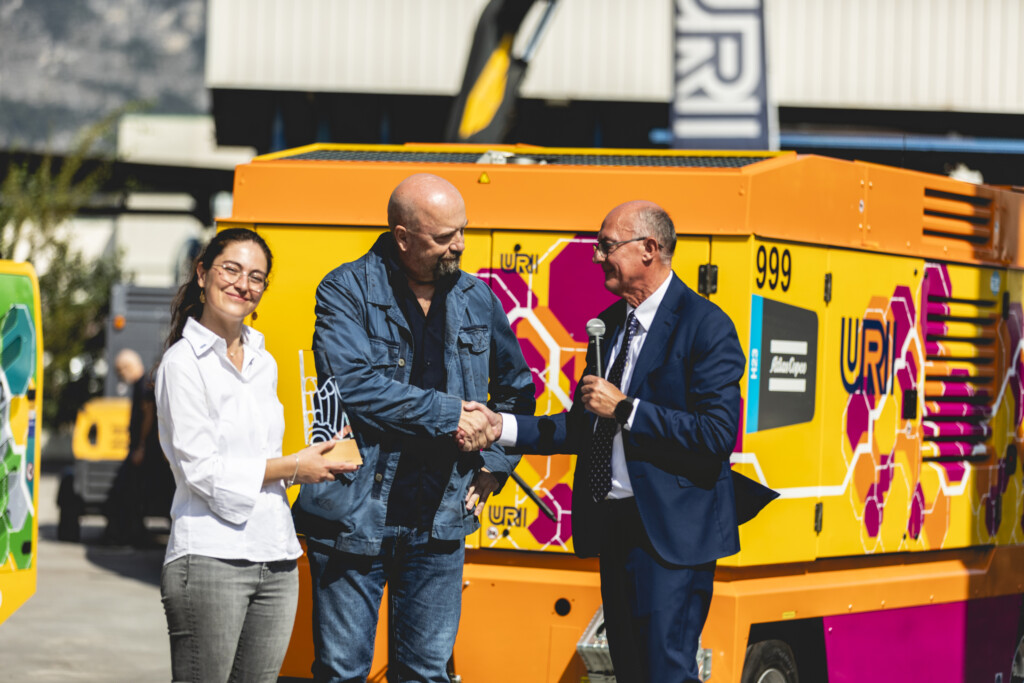
“We have a widespread presence throughout the region, offering technical support and consultancy to our clients. We collaborate with schools and vocational institutes because we strongly believe in the importance of education and in the potential of young people. For our centenary, for example, students from the Depero school curated an exhibition on the company’s history and proposed decorative designs for our machinery created by a collective of artists.
To mark this milestone, my father Silvio also wrote a book about the company’s history: URI 100 Years. 1925–2025. Its pages recount the challenges faced and the people who helped shape the company into what it is today. Their stories preserve the past and inspire the future, making URI not just a company, but a community.”
TRENTINOINDUSTRIALE.COM | OCT – NOV 2025


